
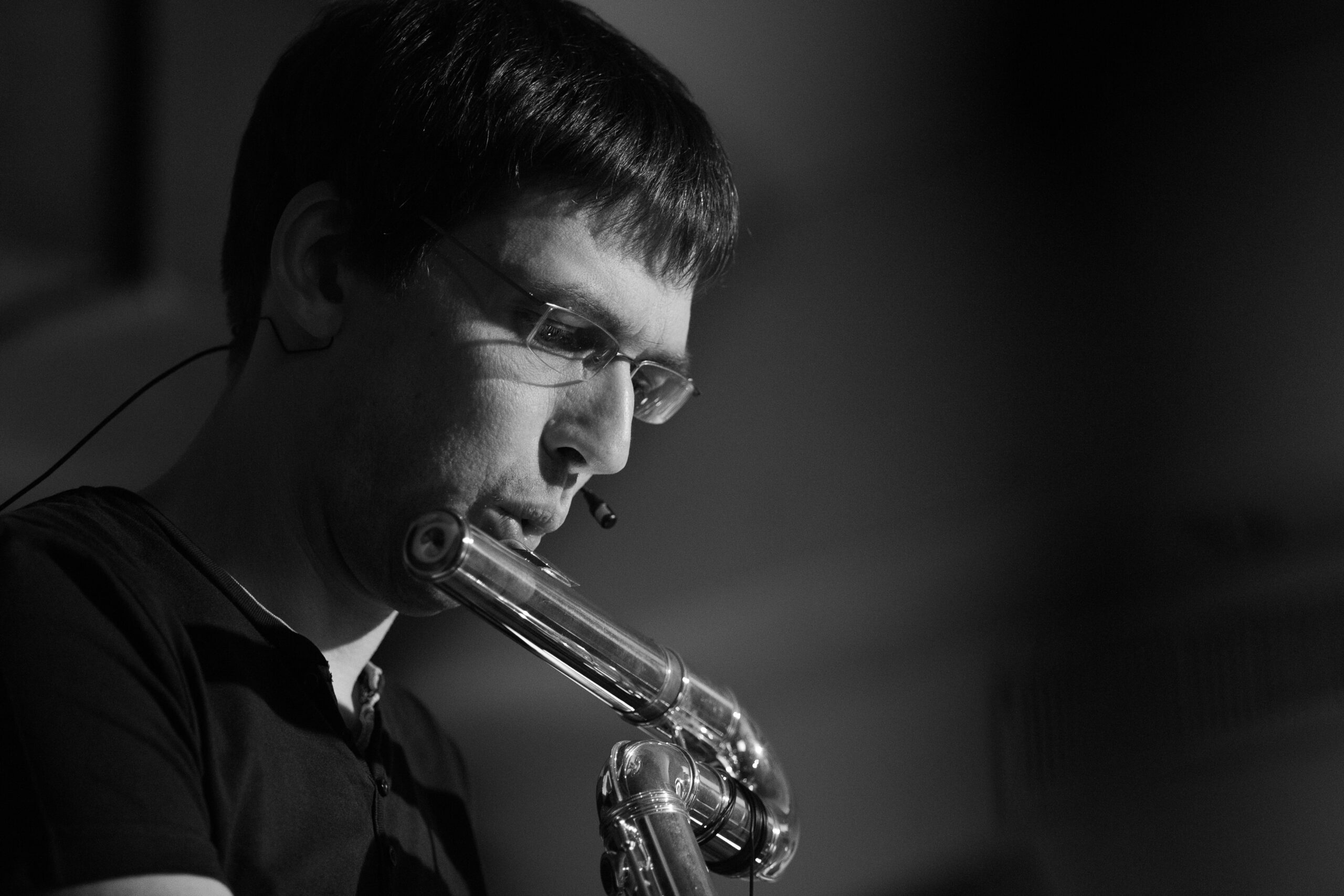
Matthieu Amiguet
An eclectic musician and researcher, Matthieu Amiguet has—over the years and through various musical encounters—enriched his classical background with jazz, rock, and world music influences, developing a musical language that feels both familiar and deeply personal. His interest in instrument making and evolution has led him to explore not only unusual transverse flutes (such as bass, contrabass, and slide flutes) but also other instruments—most notably the harpejji, a remarkable hybrid of piano and guitar, for which he is a leading global pioneer and influential figure.
His musical approach is naturally shaped by his scientific rigor: he holds a degree in mathematics and a PhD in AI (earned in 2003, long before the subject became trendy). This dual background in music and science has enabled him to conduct cutting-edge research since 2010 in the field of “augmented lutherie”—enhancing the sonic capabilities of acoustic instruments through real-time computer processing. A staunch advocate of free and open-source software, he develops the applications he uses on stage himself. He has been invited to present his research at various conferences across Switzerland and Europe, leading to numerous contacts and collaborations with musical and academic institutions in Europe and North America.
Matthieu Amiguet’s unique, eclectic musical profile has led him to perform in a wide range of settings—from the Basilica in Montreal (Quebec) to the Stravinski Auditorium in Montreux (Switzerland)—spanning contemporary music festivals, museums, jazz clubs, and even alpine pastures. He has also participated in the design and creation of installations for festivals such as Belluard in Fribourg (Switzerland) in 2017, No’Photo at the Alhambra in Geneva (Switzerland) in 2019, and the Nové Zámky Biennale (Slovakia) in 2021.