
EUTERPE: MELODIES OF THE GODDESS OF MUSIC
Musiciens
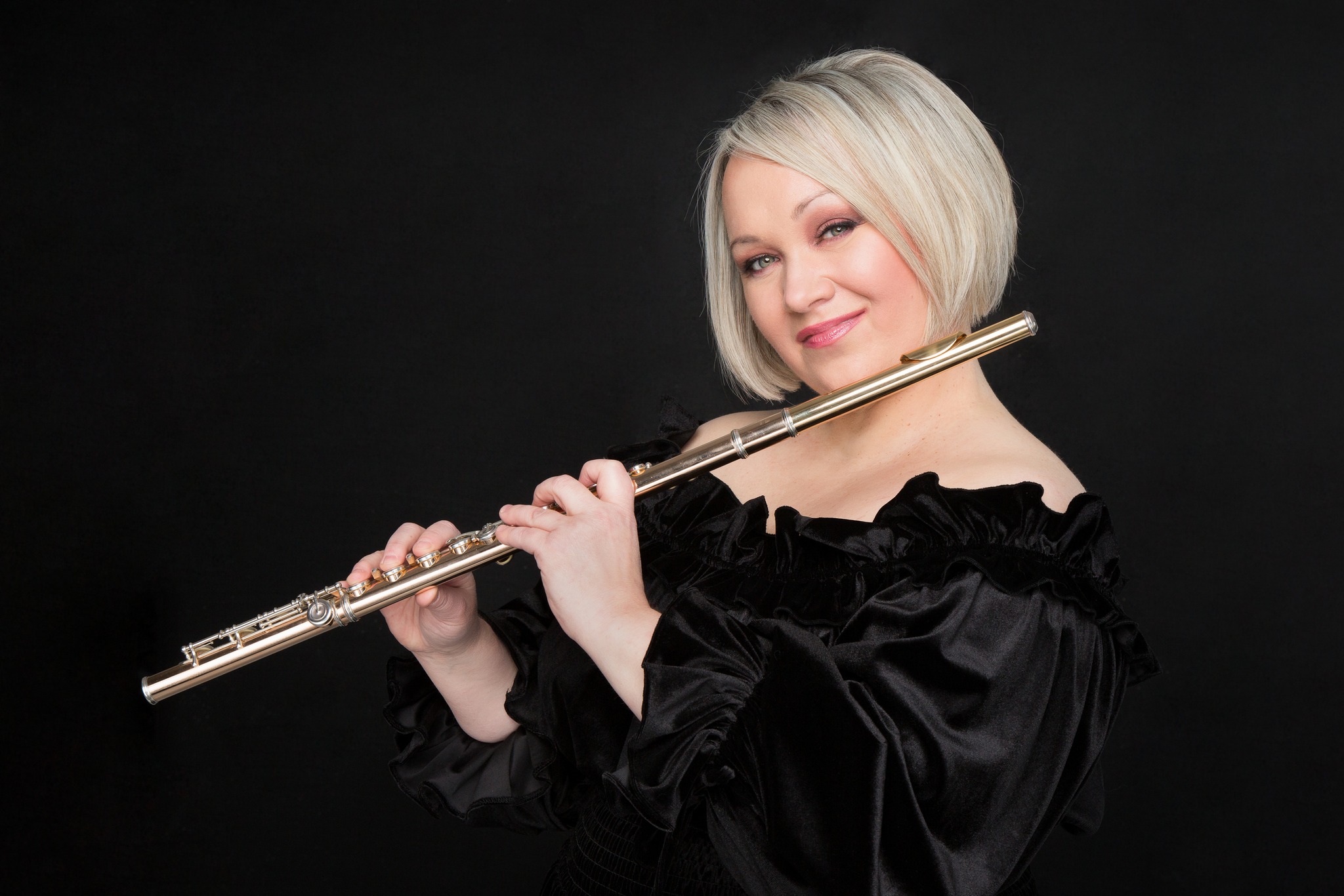
Iwona Glinka
Flûte
Présentation
Mythology played a vital role in the development of music in the XX and XXI century. Four composers notably espouse the convergence of myth and flute music: Błazewicz, Erber, Read Thomas and Travlos. Each of these composers viewed mythology differently and made unique contributions to the world of flute music, often in a form closely tied to mythology. Mythology inspired many of the great composers and provided the creative material for some of music’s greatest masterpieces.
Programme
- Michail Travlos (*1950) – Antigone (2025) (premiera) 20’
- Marcin Błazewicz (1953-2021) – Thanatos (1984-1985) 10’
- James Erber (*1951) – Four Aspects of Euridice (2014) 8’
- Augusta Read Thomas (*1964) – Euterpe’s Caprice (2008) 2’
concert 40 minutes
Originalité du projet
The originality and specificity of a project exploring the convergence of myth and 20th/21st-century flute music lies in its focus on the instrument’s evolution from an ancient ritualistic tool into an avant-garde vehicle for complex storytelling, psychological depth, and metaphysical structures.Rather than treating mythology as simple program music (such as a literal illustration of a story), the project’s specific value is demonstrated by how Błażewicz, Erber, Read Thomas, and Travlos map mythological concepts directly onto modern composition styles and unconventional instrumental techniques.
Lien avec l’identité du Golden Flute Classic et/ou du label “Signature Genève 2027”
This project brings together a geographically diverse cohort of 20th and 21st-century composers—from Poland (Błażewicz), Britain (Erber), America (Read Thomas), and Greece (Travlos). It uses the universal language of ancient myth to mirror Geneva’s intercultural identity.Artistic Excellence & Innovation: The label explicitly invites “powerful, unique, and socially engaged projects”. Shifting the narrative away from standard historical repertoires, this project centers on avant-garde composition, microtonal complexity, and acoustic research. It directly fulfills the festival’s demand for high intellectual and artistic standards.
Openness to Diverse Formats: The project naturally spans multiple mediums. It bridges solo acoustics (Erber, Błażewicz), electro-acoustic landscape music (Travlos), and choreographed theatrical ballet music (Read Thomas). This versatility offers the exact multi-format adaptability requested by the Golden Flute Classic 2027 call for projects.
By proposing a project focused on these four composers, you offer the Golden Flute Classic 2027 an identity-defining program. It honors the ancient, ritual roots of the instrument while positioning the flute as a cutting-edge medium for modern artistic expression. This balance perfectly captures the forward-looking vision of the Signature Genève label.
Pédagogie
The educational dimension of a project exploring mythology in 20th and 21st-century flute music provides a transformative training framework for advanced students and young professionals. Rather than teaching extended techniques as isolated gimmicks, this curriculum uses mythological narratives as a psychological and structural anchor. It helps students understand why a composer uses an unconventional sound, bridging the gap between technical execution and deep artistic expression.
biographies
Iwona Glinka
Iwona Glinka was born in Kwidzyn, Poland. At the age of 18 she graduated from the Music Lyceum in Gdansk with a Flute Diploma (Highest Distinction). She continued her studies at the Music Academy of Gdansk, Poland. She graduated from the Academy in 1994 with the degree of Master of Music in Performance (flute). Between 1991 and 1994, on the Baloise Holding Scholarship, she attended the Summer Courses of the Music Academy of Lenk in Switzerland with Peter-Lukas Graf. In 1992, on a scholarship from the Mayor of the City of Darmstadt in Germany, she attended the Ferienkurse für Neue Musik where she studied with Pierre-Yves Artaud. In 1996 there followed a further period of studies at the Accademia Internationale Superiore di Musica in Biella, Italy, again with Peter-Lukas Graf and later at the Ecole Normale de Musique in Paris, France, with Pierre-Yves Artaud.
Since 1995, Iwona Glinka has made Athens, Greece, her second home. In 2015, she relinquished her position with the Athens Symphony Orchestra and Hellenic Contemporary Music Ensemble to pursue a more active solo career after 20 years as an ensemble member and an orchestral musician. She currently divides her time between her family home in Piraeus and Kwidzyn. Currently she is a professor of Flute and Chamber Music at the University of Ioannina in Greece where she has taught since 2020.
She received major grants to commission, to record and to perform new works the Costopoulos Foundation (2020, 2017, 2013, Greece), the Norwegian Society of Composers (2017), the Adam Mickiewicz Institute Polish Culture Around the World (2015, 2016, Poland), the Britten-Pears Foundation (2012, UK), the RVW Trust Foundation (2012, UK), the Alberta Foundation for the Arts (2012, Canada).
Iwona Glinka has recorded extensively and appears on a dozen CDs available on the European, Canadian and US labels such as Sarton Records, Universal, BMG, Auris Subtilise, Centaur Records, Irida, Magni, Legend, Phasma Music and others, receiving multiple awards and distinctions.
In May 2009, she obtained a Doctor of Philosophy in Music Performance (flute) from the Academy of Music in Cracow, Poland, for her dissertation on and a recital of Brian Ferneyhough’s complete flute music. In 2012, she was awarded a Doctor of Philosophy in Musicology by the National and Kapodistrian University of Athens, Greece, for her research on contemporary Greek music for solo flute.
Iwona Glinka is a Yamaha Artist – playing on 14K gold Yamaha Flute 977H and she maintains a Web presence at www.travlos-glinka.com.
Iwona Glinka is a superb flutist and musician whose pure, silvery tone will lift the spirits of the most jaded listener.
David DeBoor Canfield / FANFARE MAGAZINE / May-June 2017
Glinka has gained a substantial reputation, in Europe especially but essentially worldwide, for her devotion to new and experimental music. In addition to years of playing in orchestras and chamber ensembles, she has been a tireless recitalist, promoting the music she has discovered and often inspired. Since 2015, she has resigned from orchestral playing—she was principal in the Athens Symphony—and is concentrating on her advocacy. This project, and several other discs released in the last couple of years, are part of the result of that new focus. Her performances are imaginative and committed, her technique always equal to the often considerable demands of the music.
Ronald E. Grames / FANFARE MAGAZINE / Nov-Dec 2017
Glinka has perfect mastery over the arsenal of pops, buzzes, and squeaks that has been amassed over the past century or so.
Joe Cadagin / FANFARE MAGAZINE / Nov-Dec 2017
Glinka’s performance is impeccably clean yet mightily expressive. … magnificently sensitive, while the recording captures every single nuance.
Glinka has the remarkable ability to honor the basic emotion of each and every piece, as this juxtaposition demonstrates so clearly.
Colin Clarke / FANFARE MAGAZINE / Nov-Dec 2017
… Glinka’s superb legato line the playful “The Dance” that follow is sprightly.
Colin Clarke / FANFARE MAGAZINE / May-June 2017
In “Projection for Flute Alone,” a first-class exercise in the uses of “bent” notes, multiphonics, and other modernities, composer Panayiotis Liaropoulos seemed equally smitten with the flute as it has existed everywhere, from high-art to “primitive” …. Iwona Glinka gave it a stunning performance.
Richard Buell, The Boston Globe
Her musicality and utter control of subtle nuances revealed a sophisticated musician of great taste.
Carlo Vincetti Frizzo, Composer USA
… simply brilliant …
Avant-garde & Beyond, CJSR Radio 88.5 FM (Edmonton, Alberta, Canada)
I am delighted that the splendid flautist Iwona Glinka has chosen to include my piece “Four Aspects of Euridice” in this project. I love composing for the flute: I have written ten pieces for flutes of various sizes, including the hour-long ‘Traces” cycle. “Four Aspects” was written for Iwona between 2014 and 2015 and premiered by her in Athens in 2015. It is a mediation on Rilke’s poem “Orpheus. Euridike. Hermes” and consists of four interlinked strands of music. The fourth strand only appears at the very end and is played on alto flute, unlike the rest of the piece, which is written for C flute.